Why Blue Was Used for Renaissance Paintings of Mary
Blue moon. Blue Monday. Blue blood. Blue-neckband worker.
Historically, the colour blue has had a wealth of connotations. Once believed to take mystical powers in the ancient world, centuries after the color was associated with royalty, before bluish dye was used for uniforms in the navy, hospitals and industrial factories.
Today, psychologists claim that bluish is hardwired into the human being psyche and contributed to our evolutionary development as hunter-gatherers, who one time learnt to survive in the wild among the blue skies and waters. The power of blue is and so accepted that designers frequently cull the colour to decorate offices, believing research that it boosts productivity and feelings of calm.
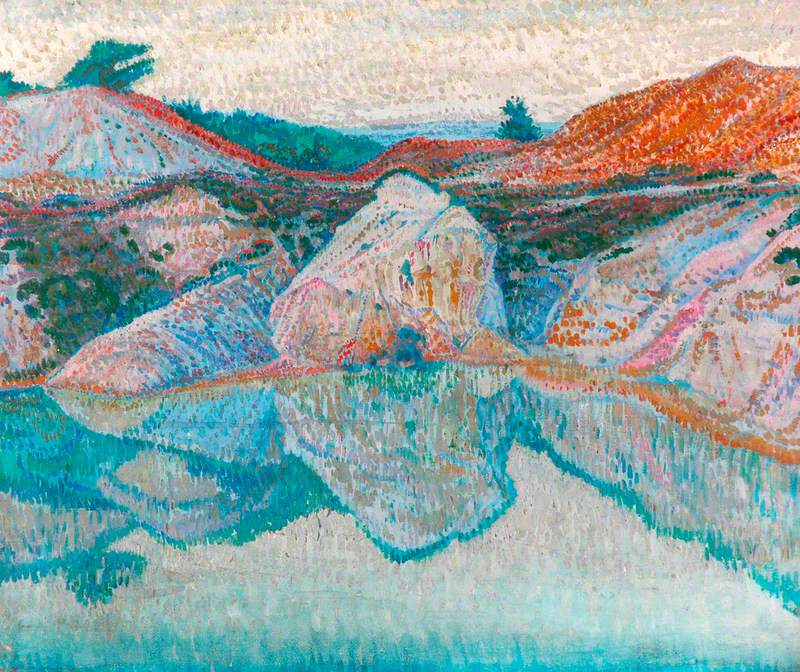
The Blue Pool
Harold Squire (1881–1959)
Bradford Museums and Galleries
A pop pigment amidst painters, Pablo Picasso, Wassily Kadinsky, Yves Klein and others all chose to base many of their works on the colour.
To kick off Fine art Uk's color series – and because the history of art is inseparable to the history of color – permit's swoop into the history, chemistry and symbolism of blue.
Lapis lazuli
The earliest forms of blueish pigment were extracted from the semi-precious limestone rock mixture 'lapis lazuli'. Originating from the Middle East, in particular, Afghanistan, the word'south etymology comes from the Latin 'lapis', which translates into 'stone', and 'lazuli' meaning 'blue'.
This pigment was regularly imported from Asia, across the Silk Road, dating back six,000 years up until the eighteenth century. Extracted from the remote Sar-eastward-Sang valley in the Badakhshan mountains in Afghanistan, it would eventually make its manner to the bustling cosmopolitan towns of western Europe.
Scholars debate that for many millennia civilisations prized the rare rock, believing information technology to accept mystical backdrop. Lapis lazuli was especially popular in aboriginal Sumer and aboriginal Arab republic of egypt when information technology was used for jewellery, headdresses and even the tomb of pharaoh Tutankhamen, besides as (allegedly) the eyeshadow of Cleopatra.
Chemist Heinz Berke points out: 'early flesh had no access to bluish because blue is not what yous phone call an earth colour... you lot don't detect it in the soil.'
The rarity and difficulty of accessing blue pigment encouraged civilisations to imbue the colour with mystical properties.
Egyptian blue
Unlike lapis lazuli, Egyptian blue is a synthetic pigment that was developed approximately 4,500 years agone. A bright crystalline substance, it is a lighter shade than lapis lazuli.
This synthetic shade was created to run into the expensive demands for lapis lazuli and blue in ancient Egypt, as they believed the color was associated with the heavens, fertility and the power of cosmos.
The pigment spread throughout Egypt, Greece and somewhen into the Roman Empire. When the Roman Empire declined, the color temporarily vanished from cultural use.
Ultramarine
Jumping alee in time, a blue pigment known as 'ultramarine' (pregnant 'beyond the ocean') became incredibly popular during the Italian Renaissance. Used widely in Europe from around the twelfth century, ultramarine is one of the well-nigh prevalent colours in western art history.
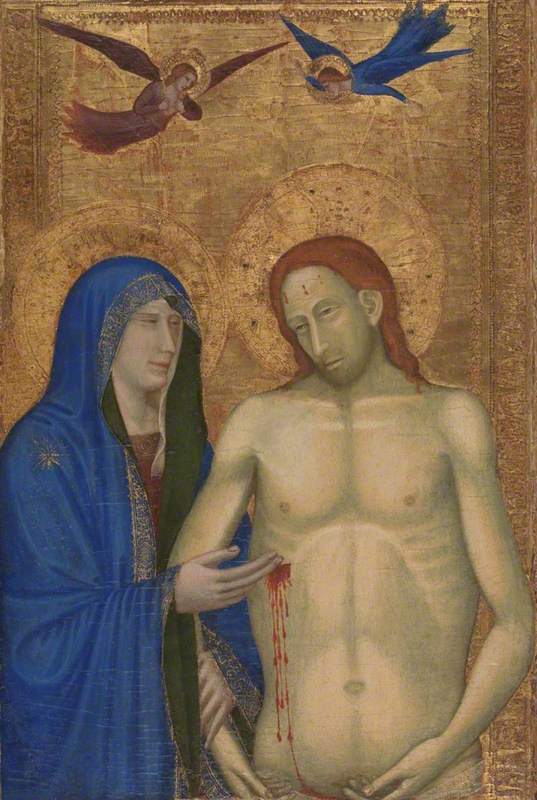
The deep blue paint was made past grinding lapis lazuli into a powder. However, when ground too finely, the blue would turn into a dull grayness.
Ultramarine was in one case so expensive it toll more than gold. Nevertheless, it became widely available and was ordinarily used past Italian artists in the fourteenth and fifteenth centuries.
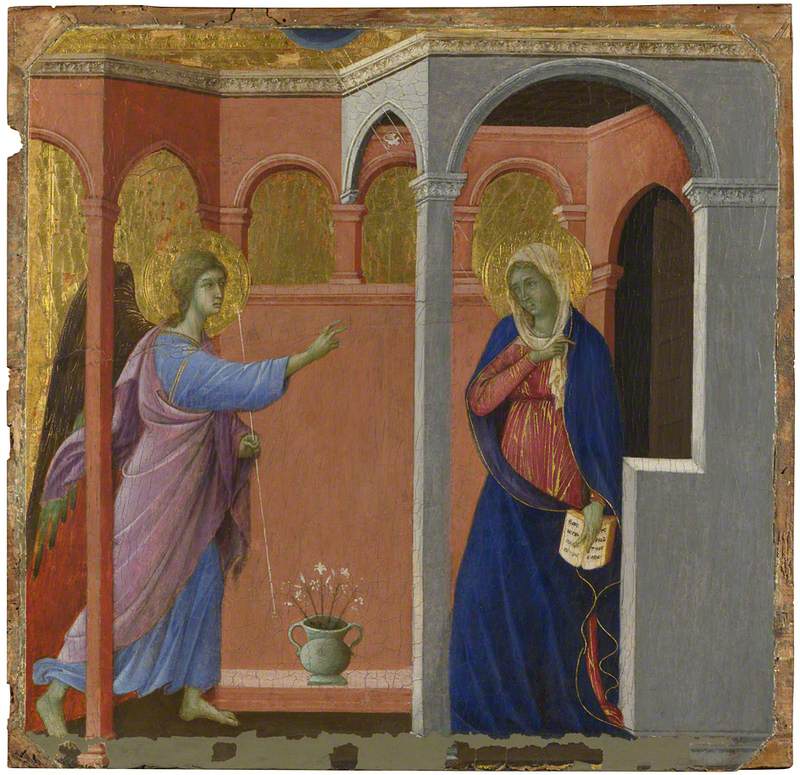
Artists similar Cimabue, Duccio and Giotto were some of the outset to regularly use the pigment, which they would oftentimes juxtapose with gold leaf.
In his Il Libro dell'Arte ('Book of Arts'), painter Cennino Cennini gave instructions on how to prepare ultramarine pigment, which involved a lengthy purification process.
Cennini wrote: 'Ultramarine blueish is a colour illustrious, beautiful, and nearly perfect, across all other colours; 1 could non say anything about it or exercise anything with it, that its quality would non still surpass.'
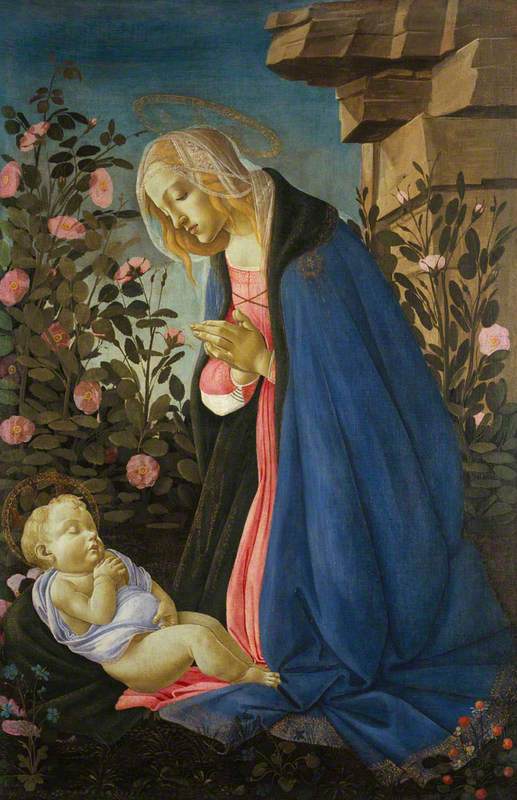
In the following centuries, artists such as Raphael, Botticelli and Titian connected to use abundant amounts of ultramarine pigment in their large-scale works.
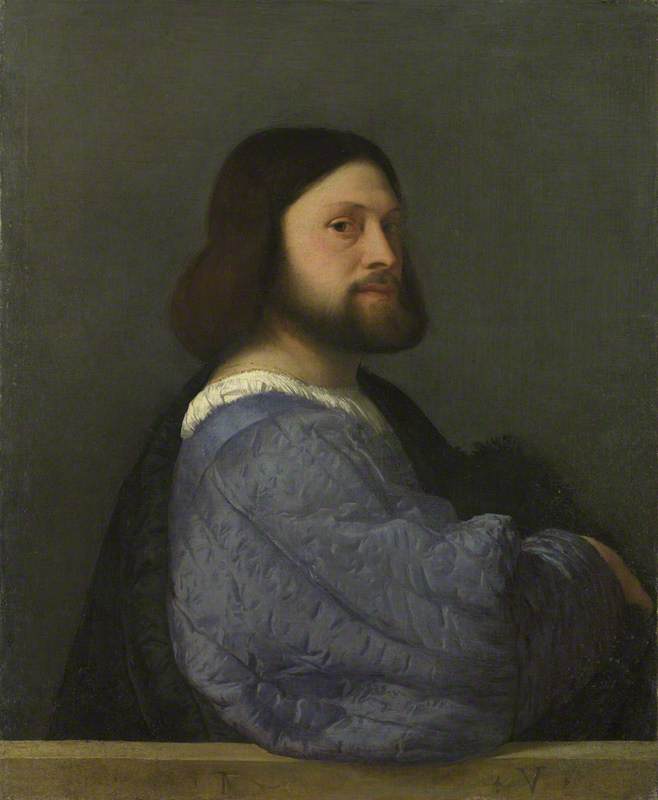
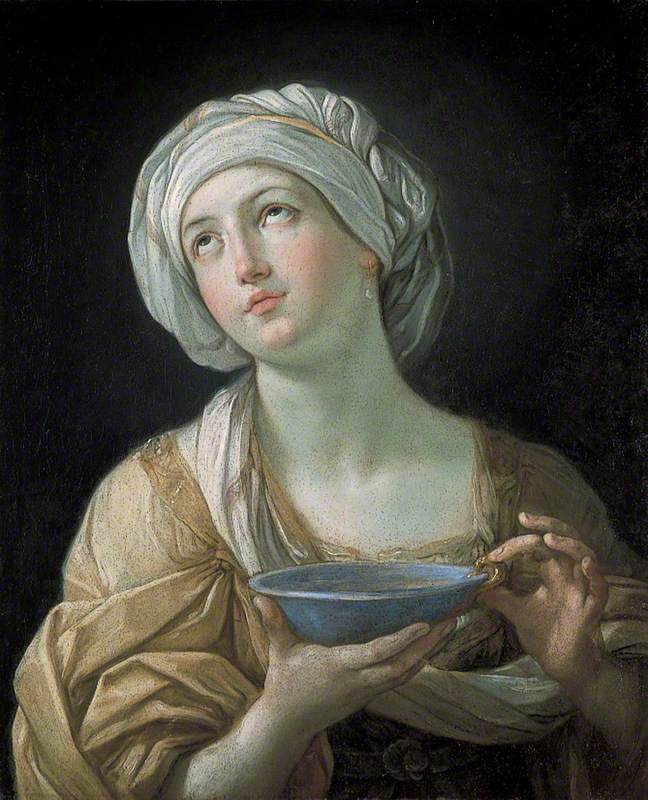
In Christian iconography, blueish became one of the most sacred colours. The religious connotations of the pigment were as well considering information technology was so expensive. Artists preserved the most costly colours for important religious subject matters, like the Virgin Mary. A particular shade was even named after her, 'Marian blue'.

Indigo
This eighteenth-century piece of work by an unknown artist shows two indigo dyers standing on either side of a dye vat. Indigo became an important colour and dye in the sixteenth and seventeenth centuries.
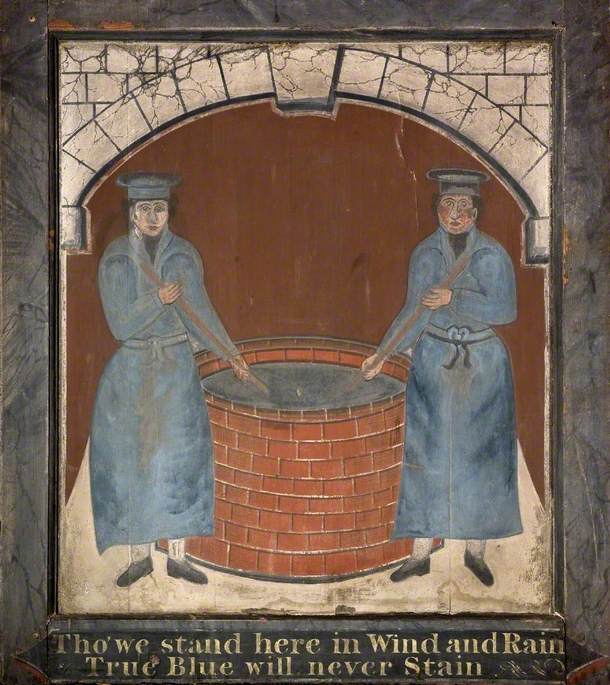
In fact, it became and so important that it ignited merchandise wars between European countries and colonised territories in the Americas, fuelled the African slave trade and became part of Sir Isaac Newton's 'colour spectrum', which he first published in 1672.
Derived from the indigo crop, known as Indigofera tinctoria, the colour was besides imported along the Silk Road, from Bharat and Egypt.
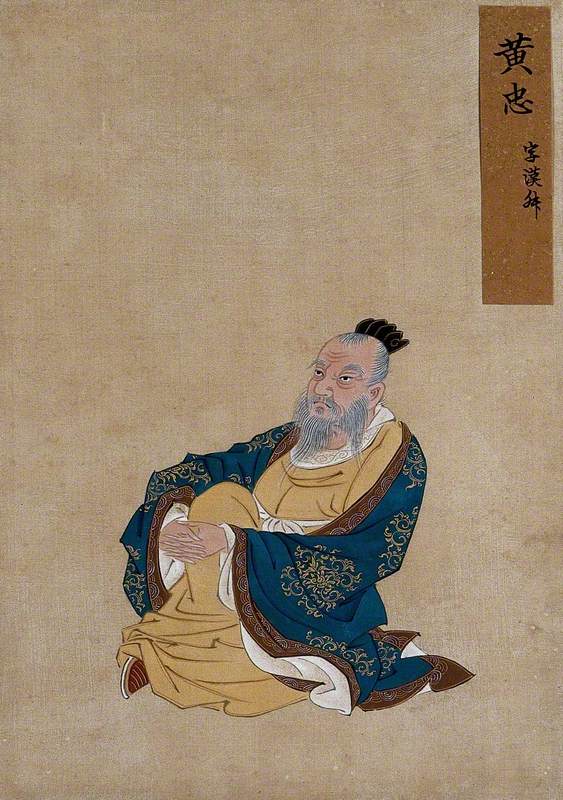
The natural dye extracted from plants was also used to dye wear. A peasant motility called the 'Indigo revolt' took identify in Bengal in 1859, when indigo farmers rose upward against their plantation owners.
The first constructed indigo dye was made by the German chemist Adolf von Baeyer in 1878, but this was replaced by the natural crop by 1913. It is this latter form of indigo that was used to dye jeans.
Prussian blueish
Prussian blue is a hue of bluish that emerged in Frg in the eighteenth century when the Swiss paint maker Johann Jacob Diesbach invented the synthesised pigment.
In March 1708, he had sent a alphabetic character to Gottfried Wilhelm Leibniz, the president of the Royal Academy of Sciences, explaining his discovery of a paint he chosen 'Preussisch blau'.
The synthetic pigment was much cheaper than ultramarine and was easier to create.
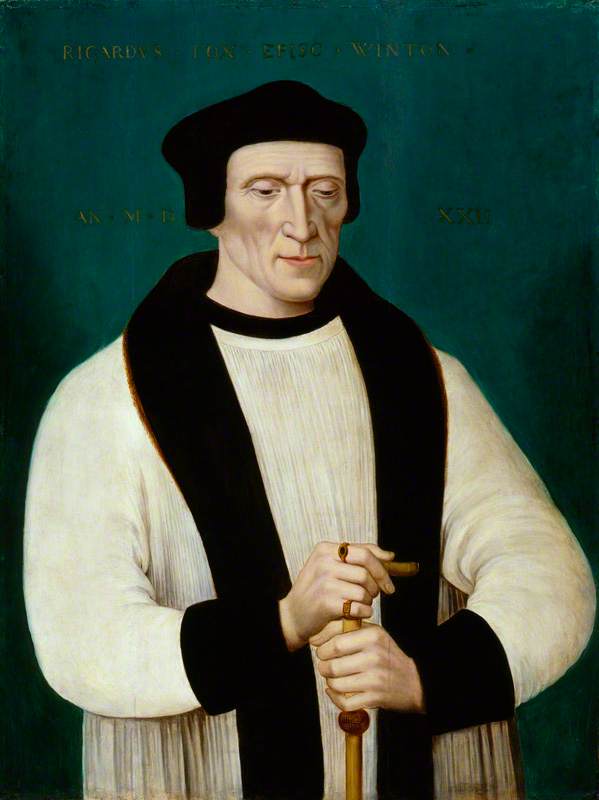
Prussian blue pigment was used in this painting showing the Tudor bishop and statesman Richard Foxe. The painting had previously been believed to be from the sixteenth century until assay of the paint showed the use of Prussian blue, which was not widely used by artists until the eighteenth century.
Although the pigment developed in Frg, it became widely used past Japanese artists, particularly Katsushika Hokusai, and is associated with woodblock prints, such as his famous Great Wave.
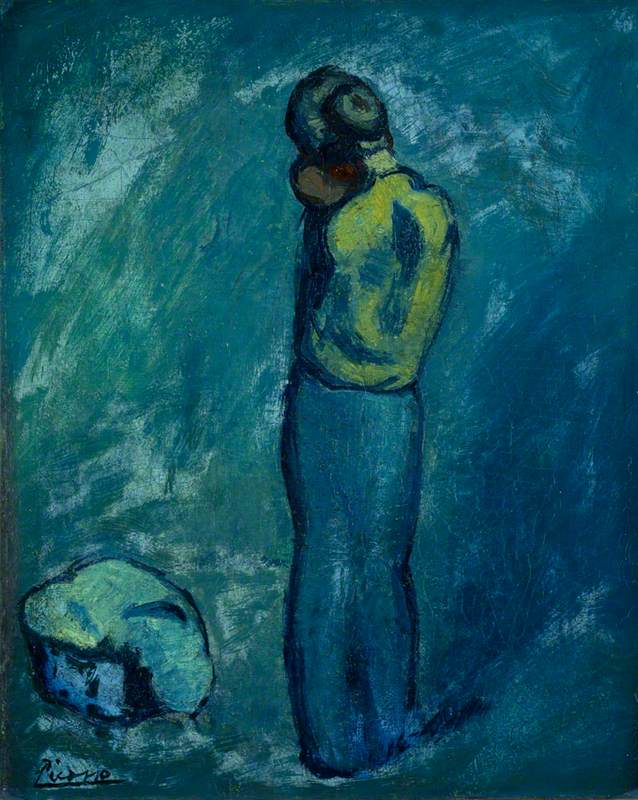
During Picasso's 'blue flow' (1901 to 1904), the Spanish artist focused on using many shades of blue, peculiarly Prussian blue.
His sombre paintings reflected the artist'southward period of depression – it marked a time when he was living in relative poverty and experiencing emotional turmoil over the suicide of his shut friend and boyfriend painter Carlos Casagemas, who had shot himself in 1901.
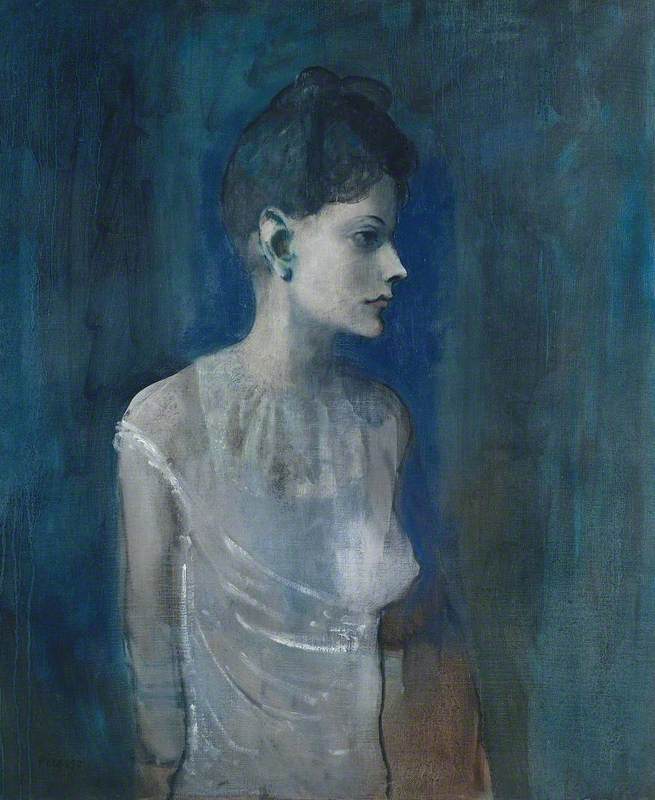
A reflection of his melancholy, his subject field matters were usually of prostitutes, drunks and beggars. Picasso's bluish period helped to strengthen the associations of the colour blueish with feelings of despair and sadness.
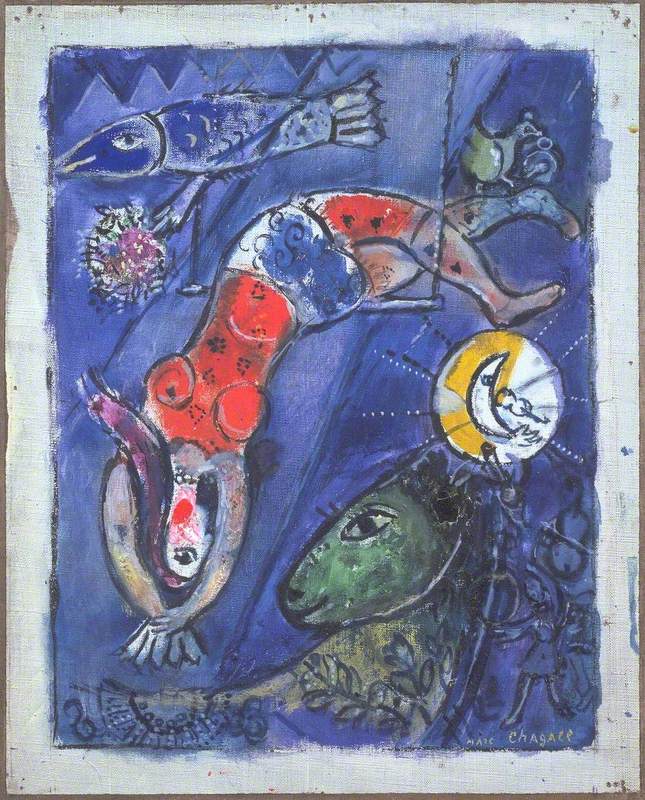
Another artist who had a potent connection to the colour blue was Marc Chagall. Picasso had once said 'when Matisse dies... Chagall will be the only painter left who understands what colour is.'
International Klein Blueish
Perhaps the artist with the most famous and indelible association with the colour blueish was Yves Klein.
In the summer of 1947, the French conceptual artist decided he wanted to capture the sky'due south expansiveness through painting, naming himself a painter of space. In the same year, he began to spray paint his canvases in shades of bluish, initially using ultramarine. He would create near 200 of these blue monochrome paintings.
Past 1960, he had created his own version of blue pigment, known as International Klein Blue (IKB).
For Klein, the color blue was intrinsic to his aesthetic philosophy: 'blue is the invisible becoming visible. Blueish has no dimensions, it is beyond the dimensions of which other colours partake.'
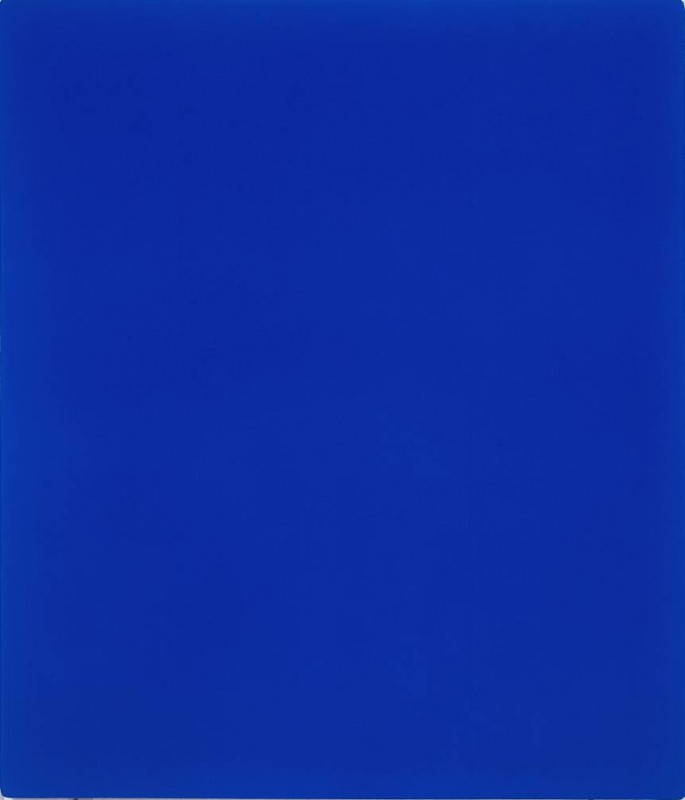
If you're blue that this is the stop of the article, wait out for more explorations of colour in art soon...
Lydia Figes, Content Creator at Fine art Britain
More than stories
Artworks
Source: https://artuk.org/discover/stories/colour-in-art-a-brief-history-of-blue-pigment
Belum ada Komentar untuk "Why Blue Was Used for Renaissance Paintings of Mary"
Posting Komentar