Assistant Professor Atlanta Georgia Georgia Institute of Technology Art
The Georgia Found of Technology, also known as Georgia Tech, is one of the nation's acme technological universities, distinguished by its delivery to improving the human status through advanced scientific discipline and technology. Founded in 1885 to help the state move beyond its agrarian roots, Georgia Tech today provides a broad technological education to more than than xvi,000 undergraduate and graduate students and conducts a $300 million-per-year research program on the cutting edge of engineering, the sciences, computing, and many other disciplines. The school is role of the University System of Georgia.
The Georgia Tech campus occupies 450 acres in the heart of Atlanta, where in autumn 2003 more than 800 full-time academic faculty members taught in vi colleges. More than 2,800 research kinesthesia and other professionals deport research and provide technology-based economical development help to help advance the land'due south economy. In all, Georgia Tech is one of Atlanta'south largest employers, with more than than 4,900 kinesthesia and staff. Beyond the Atlanta campus, Georgia Tech also operates programs in Savannah and internationally, in France and Singapore.
History
Founded in October 1885 with an cribbing of $65,000 in land funds, Georgia Tech opened its doors in October 1888 every bit the Georgia School of Technology. The initial course of 129 students studied the basics of mechanical engineering. During its first 50 years, Georgia Tech grew from a narrowly focused trade schoolhouse into a regionally recognized technological university.
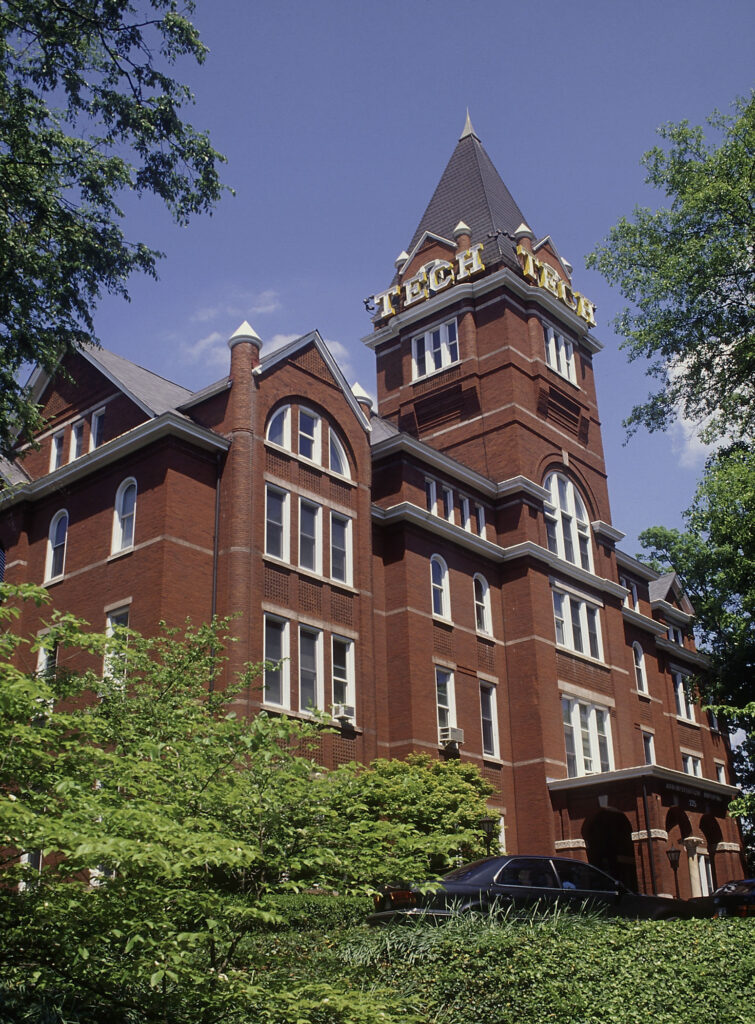
Courtesy of Georgia Tech Communications
In 1906 philanthropist Andrew Carnegie donated $20,000 to build Tech's first library. The early years of the twentieth century as well saw the introduction of the yearbook, the Blueprint (1908); the outset publication of the student newspaper, the Technique (1911); and the beginning of the Co-op Program (1912), which allows students to gain career-related experience while earning a degree. Caste programs in ceremonious, electrical, chemical, and textile engineering science were added during Georgia Tech's offset thirty years, and the legendary John Heisman became the school's beginning full-time football jitney in 1903.
The Schoolhouse of Commerce, forerunner of the College of Management, was established in 1912. In 1919 the Georgia General Assembly authorized creation of the Technology Experiment Station, planting the seeds for Georgia Tech'southward future research and industrial extension programs.
During the presidency of Marion Luther Brittain (1922-44), Georgia Tech'southward Higher of Architecture became the outset southern school admitted to the Association of Collegiate Schools of Architecture (1926), and Georgia Tech obtained accreditation from the Southern Clan of College and Secondary Schools (1930).
Reflecting a broadening curriculum and growing focus on science and advanced applied science, the schoolhouse's proper name was changed to the Georgia Institute of Technology in 1948. The postwar era marked the beginning of Georgia Tech's transformation from a regional applied science college to a nationally and internationally recognized technological academy. During this period, encompassing the presidency of Blake Ragsdale Van Leer (1944-56), Georgia Tech began offering an applied science doctoral program. Women students were admitted for the commencement fourth dimension in 1952, and in 1961 Georgia Tech became the commencement major state academy in the Deep Due south to admit African American students without a court society.
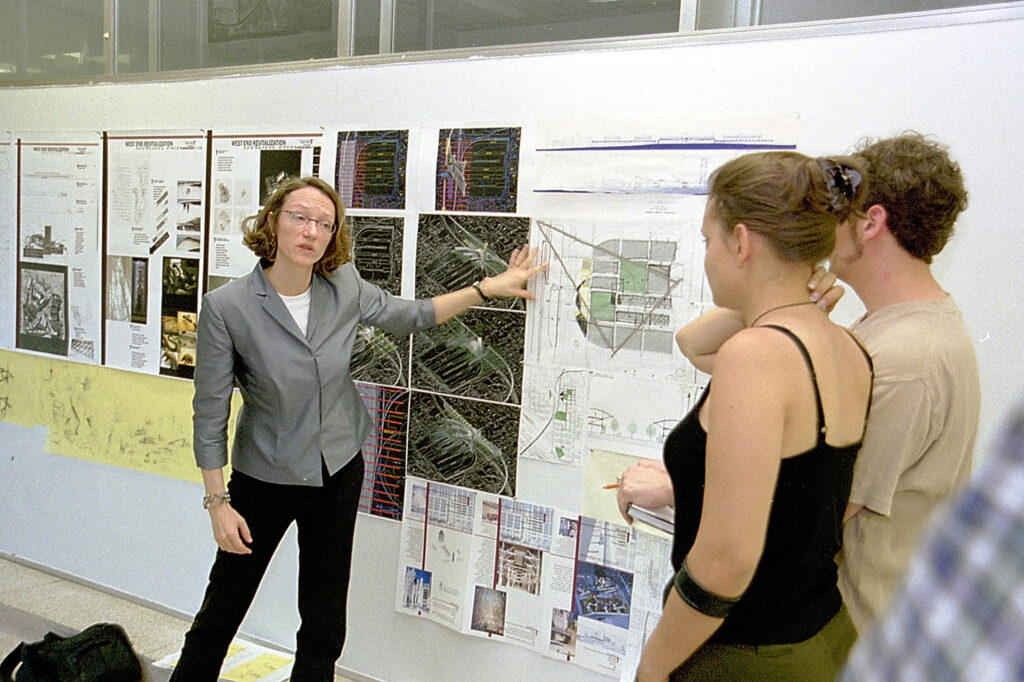
Courtesy of Georgia Tech Communications
In the 1970s, 1980s, and 1990s, nether the leadership of Presidents Joseph M. Pettit (1972-86) and John P. Crecine (1987-94), Georgia Tech grew in stature nationally and internationally, broadening grade offerings through a new Higher of Computing and the Ivan Allen College of Liberal Arts (named for Atlanta mayor Ivan Allen Jr.), dramatically expanding its research programme, and embarking on an ambitious initiative to increase the number of masters and doctoral degrees granted.
In 1994 One thousand. Wayne Clough became Georgia Tech'southward tenth president, the showtime alumnus to hold that position. During Clough's tenure a portion of Georgia Tech's campus served as the Olympic Village for the 1996 Olympic Games and accelerated expansion into the new fields of biosciences and bioengineering. Georgia Tech'south five-year majuscule campaign raised more than $700 one thousand thousand, putting the institution on a form for a massive building entrada to support its growth in academic, research, and service endeavors.
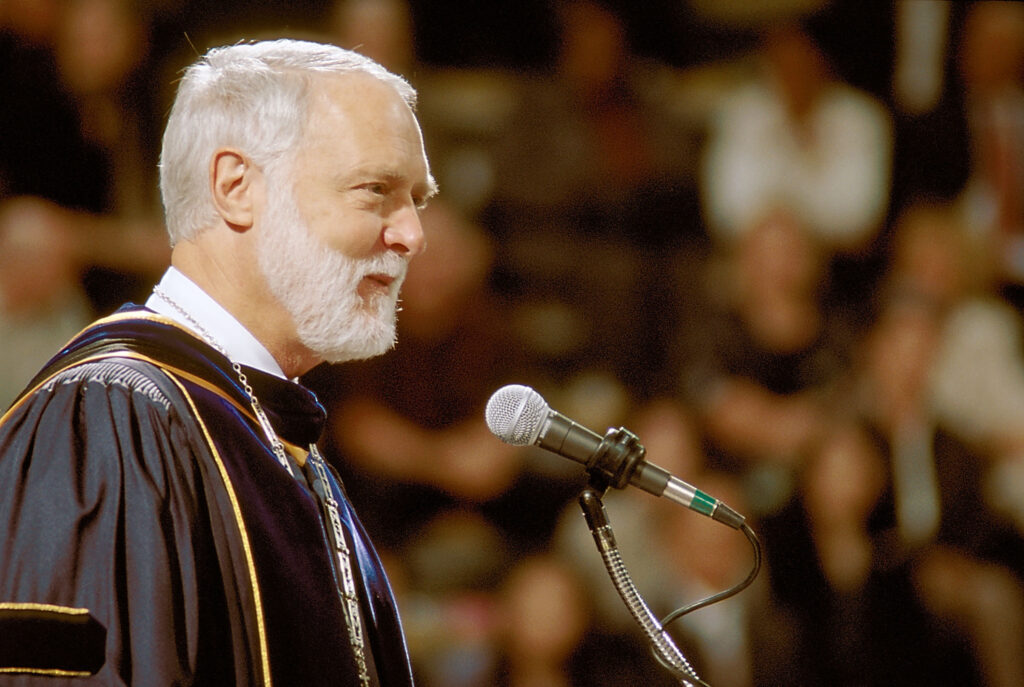
Courtesy of Georgia Tech Communications
In 1999 Georgia Tech'south engineering program was extended to students in southeast Georgia through the Georgia Tech Regional Engineering Program, based in Savannah and offered through regional and state universities in the area. In 2000 Georgia Tech and neighboring Emory Academy appear a joint Ph.D. program in biomedical engineering, providing recognition for their increasingly productive collaboration between medicine and technology and setting the stage for hereafter growth in biosciences and bioengineering. In 2005 the program was designated a national Heart of Cancer Nanotechnology Excellence, one of only seven in the state, and received a federal grant for $20 million to written report the awarding of nanotechnology to cancer handling. (The academy discontinued the undergraduate engineering program in 2012 because of funding pressures.)
Clough's legacy will include construction of the Life Sciences and Technology Circuitous, an interdisciplinary circuitous housing biosciences and environmental sciences, and the Engineering Square campus extension, a complex of buildings in midtown Atlanta. Along with the new construction, Georgia Tech has likewise preserved its historic campus, renovating for the Schoolhouse of Psychology the J. S. Coon Edifice, which one time housed the School of Mechanical Technology.
Curriculum and Campus Life
Georgia Tech offers more than 100 graduate and undergraduate degree programs, ranging from aerospace engineering science and practical biology to statistics and cloth technology. Degrees are offered in the Higher of Architecture, Higher of Calculating, Dupree Higher of Management, College of Engineering, Ivan Allen College of Liberal Arts, and College of Sciences. Georgia Tech has long been known for engineering programs that produce students gear up to brand contributions to industry and government, and its national reputation has been ascent in the nonengineering disciplines.
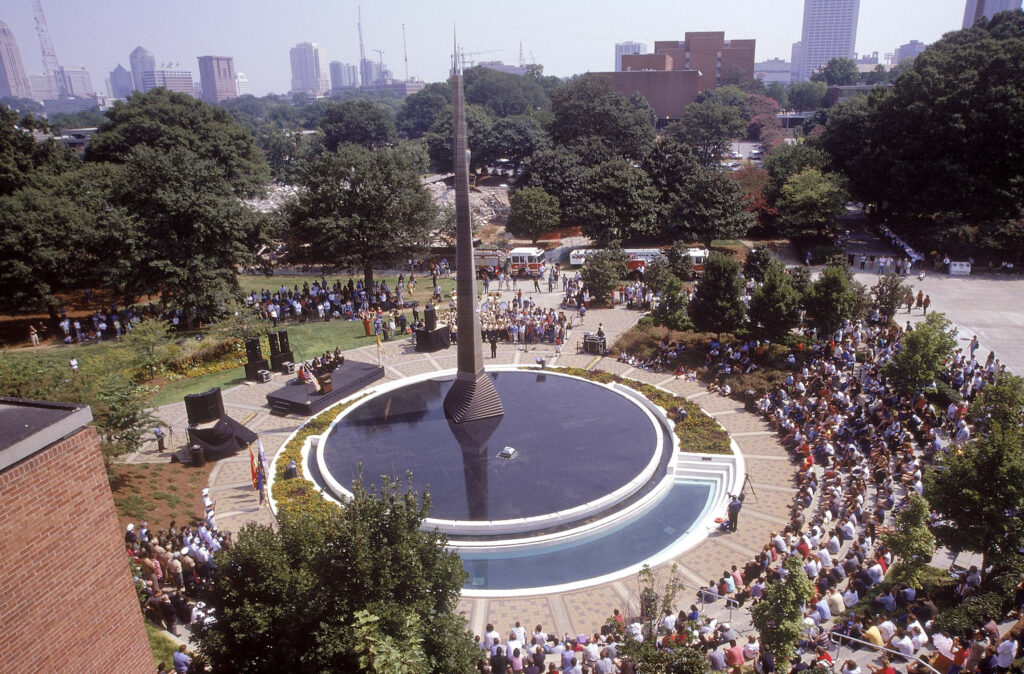
Courtesy of Georgia Tech Communications
In the College of Architecture, Georgia Tech offers programs in traditional compages, building construction, city and regional planning, and industrial design. In the College of Technology, Georgia Tech offers aerospace engineering, biomedical engineering, chemical and biomolecular engineering, civil and environmental engineering, electrical and computer engineering, industrial and systems engineering science, materials science and engineering, mechanical engineering, and polymer, textile, and cobweb technology.
The Ivan Allen College of Liberal Arts, Georgia Tech'due south newest college, includes programs in economics; history, applied science and society; international affairs; literature, communication, and culture; modernistic languages; and public policy. The College of Sciences includes applied physiology, biology, chemistry and biochemistry, globe and atmospheric sciences, mathematics, physics, and psychology.
Georgia Tech enrolled a record 16,643 students in fall 2003, including eleven,257 undergraduates and 5,386 graduate students. The 2003 freshman class averaged 1336 on the SAT, i of the highest course averages among public universities in the United States. In 2003 the annual U.S. News and World Report magazine rankings of colleges and universities placed Georgia Tech 9th among all public universities, and the College of Engineering moved into the peak v listing in its category. Minorities make upwards more a third of Georgia Tech's educatee body, contributing to high rankings in the education of Hispanic and African American engineers. Black Issues in Higher Instruction has named Georgia Tech the acme producer of African American engineers in the Usa.
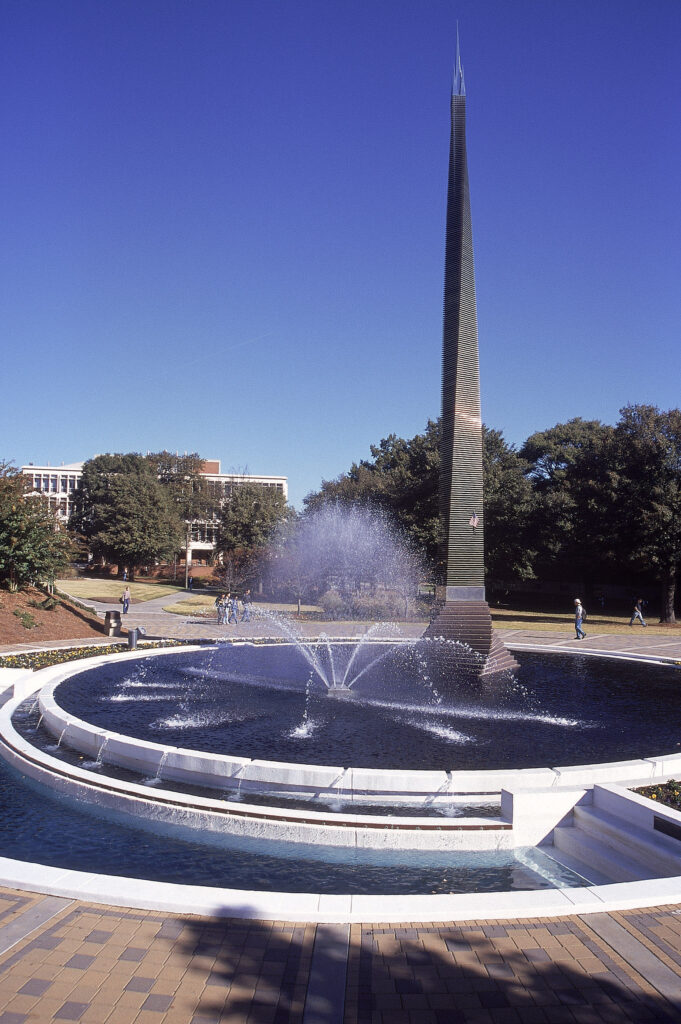
Courtesy of Georgia Tech Communications
In 2002 Georgia Tech conferred 3,532 degrees, 52 percent of them to Georgia residents. The College of Applied science continues to be the overwhelming selection of students, conferring 2,111 degrees in 2002, virtually threescore percent of all those granted. Next in the number of degrees granted were the Dupree College of Management (436), College of Computing (315), College of Sciences (276), College of Architecture (216), and Ivan Allen College of Liberal Arts (178).
Since 1912 Georgia Tech has offered a five-twelvemonth cooperative plan to students who wish to combine career-related experience with classroom studies. The program is the fourth oldest of its kind in the world, and the largest totally optional co-op program in the country. Students who enroll in this program alternate semesters between industrial assignments and classroom studies, completing the same class work as regular four-year students. In 2002, two,957 students participated in the undergraduate co-op plan, and some other 415 participated in the graduate co-op program, the largest such program in the United States for scientific discipline and technology.
Georgia Tech provides an extensive programme of career counseling and assistance, attracting employers from across the country to interview its graduates. Tech increasingly involves its undergraduate students in opportunities to participate in sponsored enquiry, with 1,350 students contributing to enquiry activities in 2002. Near 750 Georgia Tech students in the 2002-3 schoolhouse year took advantage of the opportunity to written report abroad.
Georgia Tech's Library and Data Middle houses collections of scientific and technical data, as well every bit other scholarly resources. In all, the facility houses more than three.nine million volumes, 2.7 one thousand thousand technical reports, and more than 1.iii million authorities documents. The library has access to more 3,600 electronic journals, 200 databases of citations, abstracts, and full-text and numeric data.
In 2003 Georgia Tech's faculty included twenty-four members of the National Academy of Engineering and 3 members of the National Academy of Sciences. Every bit of 2003 faculty members have earned 83 National Science Foundation CAREER Awards, which honor the most promising young talent in scientific discipline and engineering. And in 2003 4 Georgia Tech faculty members were elected to membership in the American Association for the Advancement of Science.
Georgia Tech is rich in traditions. Buzz, its Yellow Jacket mascot, encourages fans at sporting events and turns up at a surprising number of campus functions. The Georgia Tech fight vocal celebrates the "Ramblin Wreck," symbolized by a painstakingly restored yellow-and-gilt 1930 Ford Model A that leads the football team onto the field at domicile games. The Georgia Tech Athletic Clan is a nonprofit system responsible for maintaining Tech'due south intercollegiate athletic programs. Georgia Tech has won national football championships in 1917, 1928, 1952, and 1990. The Heisman Bays is named for Georgia Tech's first full-time football coach, John Heisman. Georgia Tech teams today participate in the Atlantic Declension Conference.

Image from brookenovak
The Georgia Tech Alumni Association was chartered in 1908 with the mission of promoting the institute, and today serves more than 100,000 Georgia Tech alumni. The association publishes a printed mag and paper, in improver to an online newsletter. It maintains a unique "Living History" archive containing video interviews with more 400 alumni, faculty, staff, and friends.
Research
Ranked thirtieth in the nation by the National Science Foundation (NSF) for the full volume of research ($306 million in 2001), Georgia Tech includes basic and applied research in its plan of discovery, which covers a broad range of areas from engineering and the sciences to computing, public policy, and management. The research is conducted in the academic departments, more than 100 interdisciplinary enquiry centers, and the Georgia Tech Enquiry Establish, Georgia Tech's applied enquiry arm.
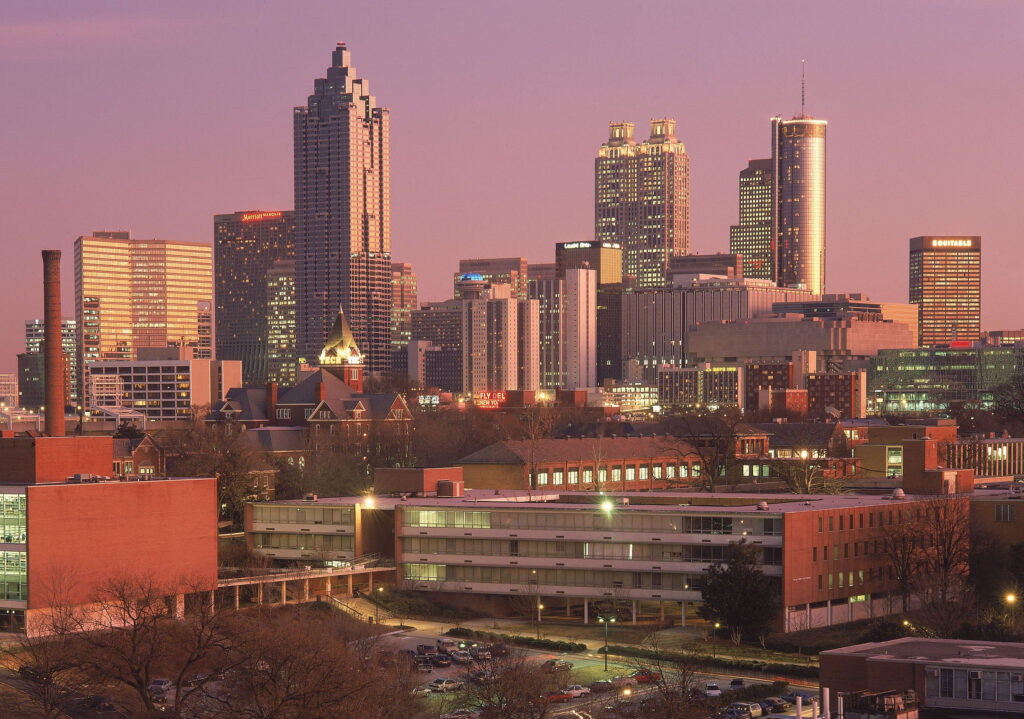
Courtesy of Georgia Tech Communications
Georgia Tech ranks second in the country for the dollar volume of applied science research and development action, behind only Johns Hopkins University in Baltimore, Maryland. Engineering programs in NSF's top 10 list include aeronautical engineering, civil engineering, electric engineering, reckoner sciences, and mechanical engineering. With a strong focus on applications, Georgia Tech attracts significant amounts of industrial back up for research, earning it a fourth-place ranking for such private sector support. The improver of a research eye in photonics tied Georgia Tech with the Massachusetts Institute of Applied science for the number of NSF-sponsored applied science research centers.
Georgia Tech receives substantial support from the NSF, U.South. Air Strength, U.S. Regular army, U.S. Navy, U.Due south. Department of Wellness and Man Services, U.South. Department of Free energy, and NASA. Beyond its federal government and industrial sponsors, Georgia Tech receives research support from local and state governments, other colleges and universities, and strange companies and governments.
The Georgia Tech Research Institute (GTRI), an integral part of Georgia Tech, is a nonprofit applied research organization. Chartered past the Georgia Full general Associates in 1919 and activated in 1934 as the Applied science Experiment Station, GTRI plans and conducts focused programs of innovative inquiry, working with Georgia Tech's academic colleges and interdisciplinary centers. During fiscal 2002 GTRI's 486 full-time engineers and scientists and 241 total-time support staff attracted $113 million in contract awards and grants.
In 2002 Georgia Tech received 40 patents and filed at to the lowest degree 188 invention, software, and copyright disclosures. More than two dozen inventions were licensed, demonstrating the commercial value of the innovations produced by Georgia Tech'southward enquiry program.
Examples of specific Georgia Tech research projects include:
— development of microneedles for the painless delivery of drugs and vaccines through the peel;
— investigation of how fish affect the growth of seaweeds and corals in the Florida Keys;
— awarding of simulations developed to study water flow around dams and bridges to meliorate empathise blood menstruum through bogus heart valves;
— development of tiny structures known as "nanosprings" that could have applications equally industrial sensors and in equipment small plenty to be implanted in the human body;
— invention of a "reconnaissance circular" that soldiers could fire to observe enemy positions obscured by copse or buildings;
— laboratory testing of a new process that could remove underground chemical contaminants in a more toll-effective style;
— improvement of the interface for an industrial screen-printing machine to brand it more user-friendly to international users;
— development of a nanometer-calibration optoelectronic device that performs basic logic operations;
— discovery of a chemic technique for reducing the size of DNA structures, allowing them to be more tightly packed;
— cosmos of ultra-fast simulations to support work on improving the speed, reliability, and security of computer networks;
— development of an acoustic technique for decision-making the squealing sounds produced by brakes in automobiles, trucks, and buses;
— discovery of unique and unexpected electrical properties of metal clusters at very depression temperatures.
Economical Development
Economical evolution, a central component of Georgia Tech's mission since its formation in 1885, is carried out by the Office of Economic Development and Technology Ventures. The organization helps entrepreneurs start new companies, works as part of the state'south economic development squad to attract companies to Georgia, helps Georgia communities plan for growth, provides a wide range of assistance to Georgia business organization and manufacture in such areas every bit information engineering science and lean enterprise solutions, assists Georgia Tech faculty in commercializing technological innovations, and helps industrial companies proceeds admission to innovations developed in the Georgia Tech inquiry program.
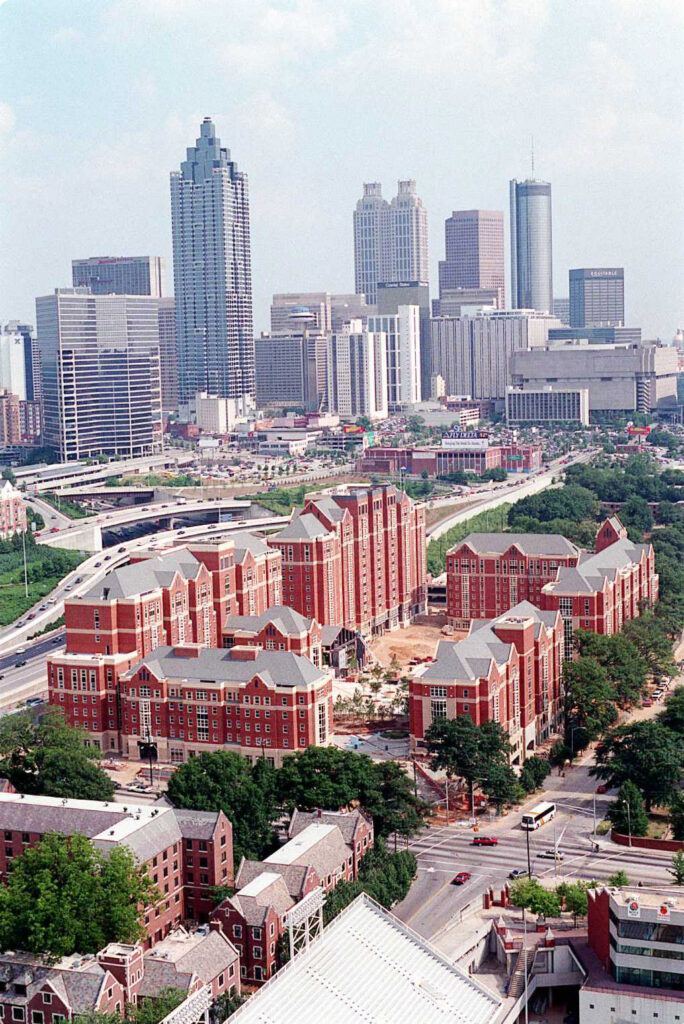
Four major units contribute to the mission: the Avant-garde Technology Development Middle (ATDC), which helps Georgia entrepreneurs launch and build successful technology companies through incubator programs in Savannah, Warner Robins, Columbus, and Atlanta; the Economical Development Institute, which provides engineering science-driven solutions for Georgia businesses, communities, and economic developers through a statewide network of sixteen regional offices; Georgia Tech VentureLab, which helps faculty and students commercialize the engineering science they develop, working in tandem with Georgia Tech's Role of Technology Licensing; and Georgia Tech's Strategic Corporate Partners, which builds relationships with industrial companies, marketing intellectual property adult at Georgia Tech, and facilitating industrial research and collaborations.
External investment in technology companies assisted past the ATDC totaled more than $94 million for calendar year 2002. During that year incubator companies generated more than than $684 million in revenues and provided more four,900 high-tech jobs. Overall, 40-4 companies participated in the program. Georgia Tech operates three incubator facilities in Atlanta, along with programs in Columbus, Savannah, and Warner Robins.

Epitome from William Brawley
During fiscal twelvemonth 2003 Georgia Tech's VentureLab evaluated the commercial potential of forty-v research innovations adult by 60 Georgia Tech faculty. The work brought to 135 the number of technologies evaluated by VentureLab since its formation in 2001. Seven new companies were formed effectually this Georgia Tech intellectual property during fiscal year 2003, and these new ventures are receiving help designed to help them get commercially successful.
Assistance from Georgia Tech'southward Economic Development Institute (EDI) to Georgia companies resulted in the creation or retention of 4,536 jobs during 2003. During that same twelvemonth EDI served i,649 companies through projects, technical assists, counseling sessions, and information assists. Georgia Tech's assistance helped companies reduce operating costs by more than than $20 million, helping them go more competitive and productive in world markets.
As part of Georgia's economic evolution team for prospective or expanding businesses, EDI helped concenter more than than $41 1000000 in new capital investment and helped create or retain 730 jobs. During fiscal year 2003 the establish assisted 91 Georgia counties in preparing for growth and planning for futurity economic development, and completed a total of 140 economic development projects for communities, along with 14 economic and financial impact analyses for Georgia state agencies.
In 2003 Georgia Tech opened its new Applied science Square campus, a $256 million expansion that reconnects its traditional campus to midtown Atlanta across the Interstate 75/85 Downtown Connector. A dramatic demonstration of public-private partnerships, Engineering Square houses the Dupree College of Management, Global Learning Conference Centre, Economic Development Institute, Avant-garde Technology Evolution Middle, Barnes and Noble Bookstore, and Georgia Tech Hotel. The new Technology Square Research Building hosts several research groups, including the Georgia Electronic Design Center.
A study conducted in 2003 showed that Georgia Tech graduates make a large contribution to Georgia's economy. The earning power of the 5,472 Georgia residents who graduated from Georgia Tech between 1993 and 1997 added $102 meg in economic impact to the land, reflecting an boilerplate salary of more than $46,000 for recent graduates. In 2004 Georgia Tech'southward annual budget totaled $729 million.
Source: https://www.georgiaencyclopedia.org/articles/education/georgia-institute-of-technology-georgia-tech/
Belum ada Komentar untuk "Assistant Professor Atlanta Georgia Georgia Institute of Technology Art"
Posting Komentar